
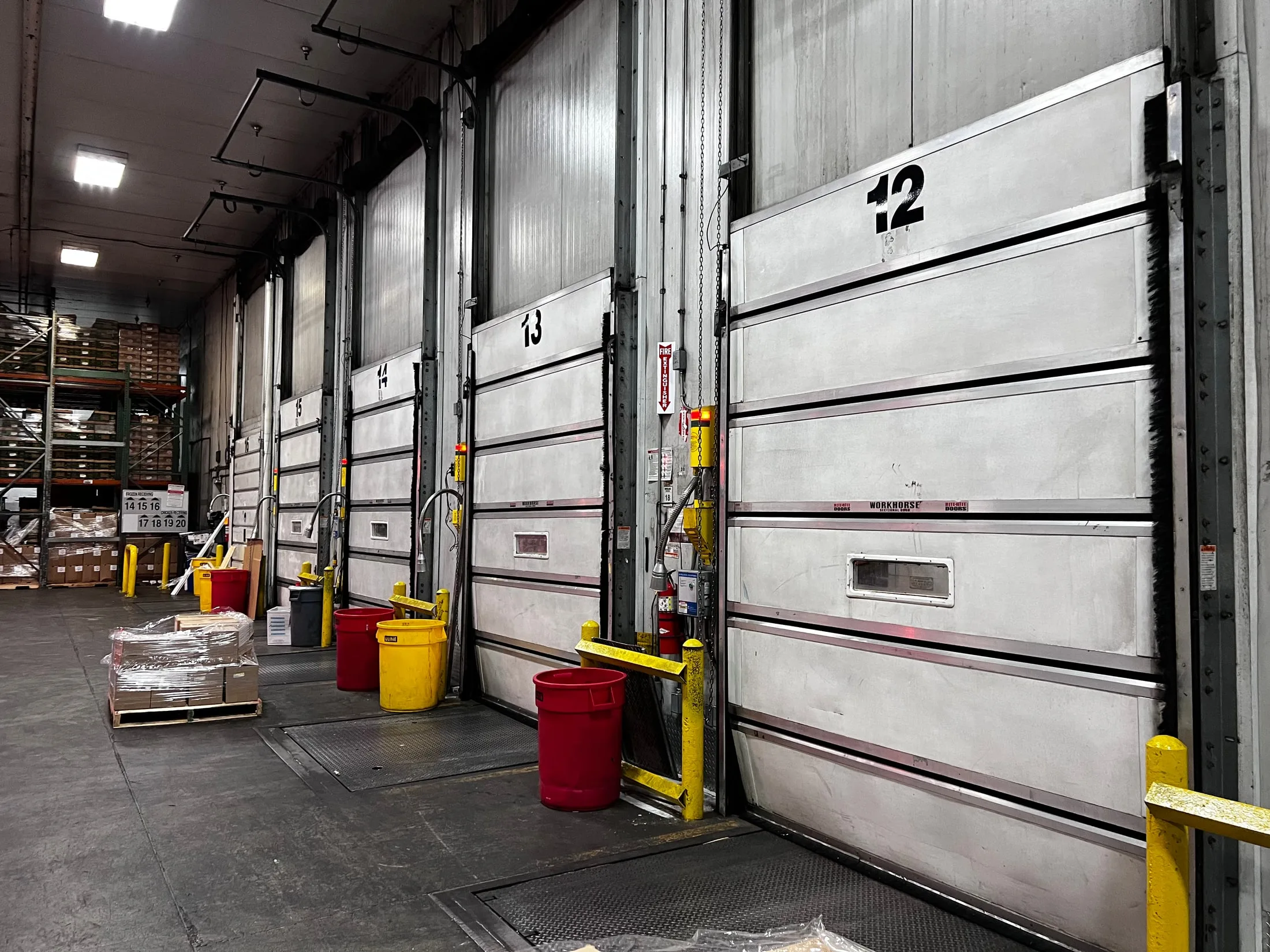
A commercial overhead door problem can start with a loud cycle, a crooked section, a failed operator, or a door that simply will not move. In a Los Angeles warehouse, distribution center, manufacturing building, or commercial property, the effect can reach well beyond the opening itself. Access slows down, a bay becomes unavailable, security changes, and the facility team has to decide how urgent the problem really is.
This guide explains the most common commercial overhead door repair issues in Los Angeles County, what to do when a door fails, which details affect urgency and cost, and how to prepare a clearer service request.
Why commercial overhead door reliability matters in Los Angeles County
Los Angeles County contains a dense mix of freight, warehousing, food distribution, manufacturing, studio, aviation, and light-industrial operations. Facilities in and around Long Beach, Carson, Vernon, Commerce, the City of Industry, the San Fernando Valley, and other industrial markets often depend on overhead doors for shipping, receiving, vehicle movement, secured access, and separation between operating areas.
That operating context changes the practical meaning of a door failure. A lightly used secondary opening and a high-cycle shipping door may have similar hardware, but they do not create the same disruption when unavailable. The Port of Los Angeles reported handling 10.2 million twenty-foot equivalent units in 2025, one indicator of the freight activity moving through the region and the facilities that support it.
For a facility team, the useful question is not only whether the door still moves. It is whether the opening remains safe, controlled, dependable, and suitable for the traffic and operating conditions around it.

Common commercial overhead door problems
Commercial sectional doors, rolling steel doors, and related powered systems can fail in different ways. The symptom helps narrow the service category, but it does not always identify the failed component. Common problems include:
- Broken, fatigued, or improperly balanced springs
- Frayed, loose, or damaged lifting cables
- Bent tracks, worn rollers, or a door that has moved out of alignment
- Dented or damaged sections following forklift, truck, or equipment impact
- Operator, control station, sensor, photo-eye, or limit-setting problems
- A door that is noisy, uneven, slow, stuck open, or stuck closed
- Bottom seals, perimeter weather seals, or brush seals that no longer close the opening properly
- Intermittent operation that becomes less reliable over time
Review commercial overhead door repair support
An uneven door may involve cables, springs, tracks, rollers, impact damage, or more than one condition at the same time. Repeatedly cycling the equipment to see whether it corrects itself can add damage or turn an intermittent problem into a complete shutdown.
What to do when a commercial overhead door fails
Start with the opening and the people or equipment around it. If the door is moving unpredictably, hanging unevenly, showing loose components, or creating an obvious hazard, stop traffic through the area and prevent further operation until the condition can be evaluated.
A practical first response usually includes:
- Stop repeated cycling and do not force the door with the operator or by hand
- Isolate the opening if movement, loose parts, or a damaged section could create a hazard
- Reroute forklifts, vehicles, deliveries, and pedestrian traffic to another usable opening
- Protect inventory, conditioned areas, and site security if the door is stuck open
- Photograph the full door, tracks, damaged area, operator, and visible equipment label
- Record what happened immediately before the failure and whether impact was involved
- Note any sound, uneven movement, fault code, or intermittent behavior
Springs, cables, shafts, drums, and other counterbalance components can store substantial energy. Troubleshooting by untrained facility personnel should not include loosening, removing, or adjusting high-tension components.
How urgent is the repair?
Repair urgency depends on safety, access, security, and operating impact—not only on whether the door is technically moving. A condition deserves faster attention when any of the following is true:
- The door is moving unevenly, dropping, binding, or behaving unpredictably
- A spring, cable, track, section, bracket, or other component appears damaged or loose
- The door is stuck open and the facility cannot secure the opening
- The door is stuck closed and blocks a critical bay, route, production area, or emergency access point
- The opening affects temperature control, dust separation, pest exclusion, or product protection
- A recent vehicle or forklift impact may have changed alignment or structural condition
- The problem is recurring, worsening, or causing employees to use informal workarounds
If another opening can safely carry the traffic and the affected area can be secured, the operational urgency may be lower. That does not make the underlying condition safe to ignore; it gives the facility a better temporary operating plan while the door is evaluated.
What a commercial overhead door evaluation may need to cover
A complete evaluation may extend beyond the first visible symptom. Depending on the door and failure, relevant areas can include the door construction, counterbalance system, lifting components, track and roller alignment, panels or slats, powered operator, controls, safety devices, seals, attachment points, and the condition of the surrounding opening.
Cycle volume and repair history matter as well. A component failure on a frequently used shipping door may be part of a larger wear pattern. A door struck by equipment may need more than a panel replacement if tracks, guides, brackets, or the opening itself also moved.
Facility teams do not need to diagnose each part before asking for help. They do need to communicate the symptoms and site conditions clearly enough for the service need to be routed and prepared correctly.
What affects commercial overhead door repair cost in Los Angeles?
There is no credible single price for commercial overhead door repair in Los Angeles without knowing the equipment and failure. A small adjustment, a high-tension component replacement, impact damage, and an operator problem involve different parts, access needs, labor, and risk.
The main cost variables usually include:
- Door type, dimensions, weight, construction, and insulation
- Manual operation versus a powered operator and control system
- The failed components and whether compatible parts are readily available
- The extent of impact damage or misalignment beyond the obvious symptom
- Required access equipment, working height, and space around the opening
- Facility access rules, operating hours, escorts, badging, and shutdown windows
- Urgency, after-hours requirements, and the ability to secure or bypass the opening
- Whether repair is practical or replacement is the better long-term decision
Useful pricing follows a clear description and an appropriate evaluation. Publishing a broad range without those facts would create more confusion than guidance.
Repair or replace the overhead door?
Repair is often reasonable when the damage is localized, the door remains structurally serviceable, replacement parts are available, and the repaired system still fits the facility's needs. Springs, cables, rollers, controls, seals, and some damaged sections may fall into that category depending on the overall condition.
Replacement becomes more likely when impact damage affects multiple sections or structural components, corrosion or wear is widespread, parts are obsolete, failures keep returning, or the existing door no longer fits the opening's traffic, security, speed, or environmental requirements.
The decision should account for the full system and the cost of continued disruption—not only the price of the next part. A frequently failing door can remain repairable in a narrow technical sense while still being the wrong operational decision.
Commercial overhead door, roll-up door, or high-speed door?
People often use commercial overhead door and roll-up door as broad search terms, but the equipment is not always the same. A sectional overhead door uses hinged sections that travel along tracks and typically move overhead. A rolling steel door coils slats around a barrel above the opening. Sheet doors, fire-rated rolling doors, counter doors, and other products have their own construction and service considerations.
High-speed doors are another category designed around rapid cycling and specific traffic or environmental needs. Identifying the door type helps avoid sending the request down the wrong path, especially when controls, curtains, guides, or specialty parts are involved.
What to document before requesting service
A strong service request gives the next person enough information to understand the equipment, location, symptoms, and operational pressure. Before submitting a request, gather what you can from the following list:
- Facility address, best site contact, access instructions, and the affected bay or door number
- Door type and approximate width and height
- Manufacturer, model, serial number, and operator information when visible
- Wide photos of the opening plus close photos or video of the problem
- A short description of what the door does, does not do, or did immediately before failure
- Whether the door is open, closed, secured, usable, or isolated
- How the problem affects shipping, receiving, production, security, temperature, or access
- Alternate openings available and the facility's acceptable service window
- Known impact, previous repairs, or a pattern of similar failures
Clear information can reduce back-and-forth, help determine the right equipment category, and make it easier to arrive prepared for the site conditions.
Los Angeles facility context worth including
Los Angeles County is not one uniform service environment. A secured logistics yard in Carson, a food facility in Vernon, a manufacturing operation in the City of Industry, and a warehouse in the San Fernando Valley may have different traffic, access, operating-hour, temperature, and compliance needs.
Include the facility type, area, shift pattern, approximate door cycles, loading schedule, site restrictions, and any temperature, security, sanitation, or pest-exclusion concern. Even when those details do not change the failed component, they can change the priority, preparation, access plan, and type of support the facility needs.